Kinesense DEAM
DEAM Digital evidence and asset management
Digital evidence and asset management for police
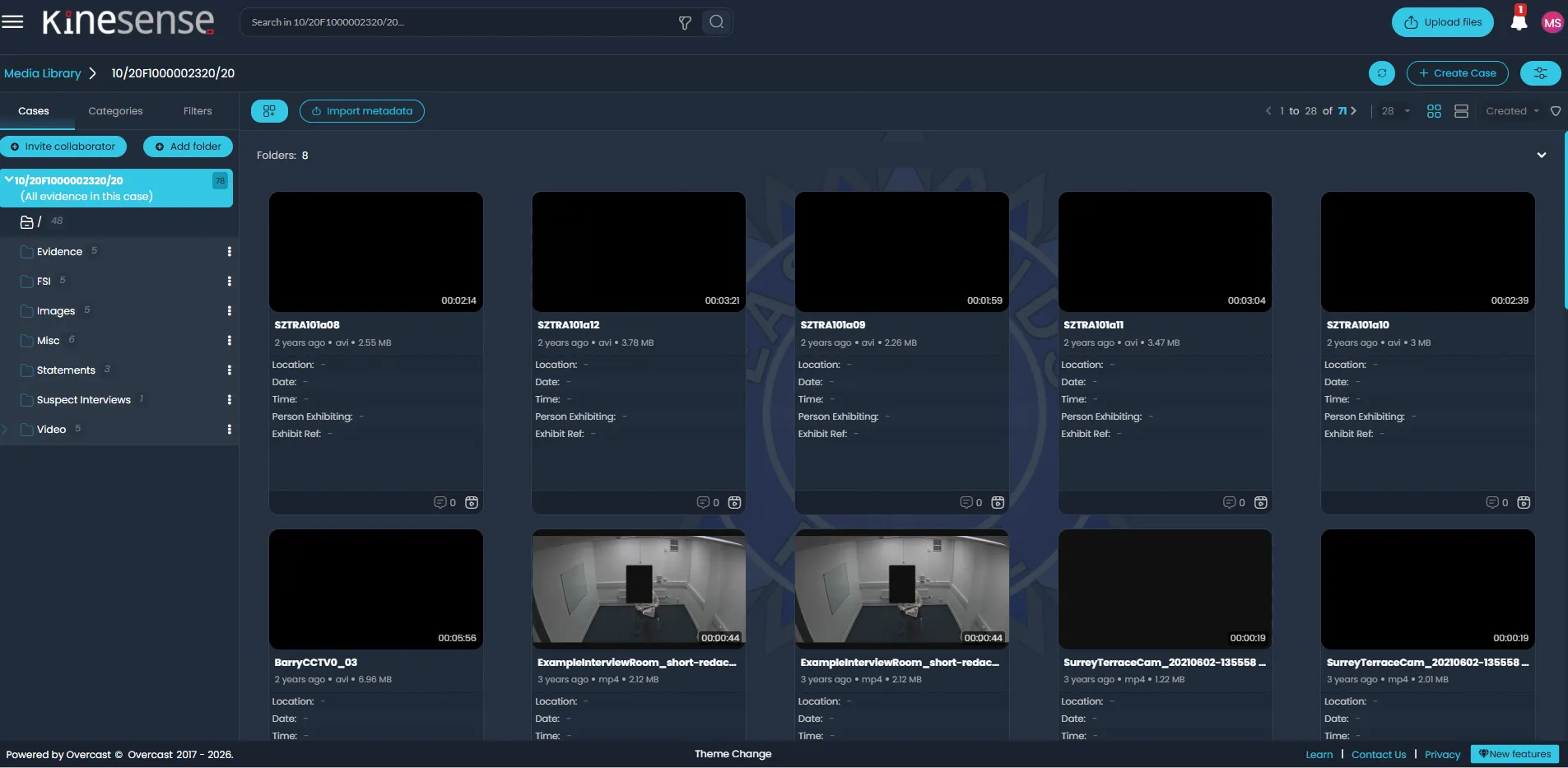
A complete digital evidence management (DEM) and digital asset management (DAM) solution for police. As well as documents, records, reports, photos, interview recordings, audio and forensic images, it is specifically designed to support video from CCTV, mobile phones and body worn cameras.
Cloud
native
Role-based
access
Full
API
What is a digital evidence management system?
A digital evidence management system or digital asset management system is a web-based solution for bringing all of your evidential assets together in one central location so that they can be accessed securely and easily by everybody who needs them simply by logging into one application. It joins all the disparate systems so that evidence is instantly available in a readable or playable format regardless of the original source.
Featured highlights
Eliminate the costly physical transfer of assets
Import and upload digital media to a case, add a reference to the case, and share with colleagues and prosecutors alike. Search for videos using key metadata tags.
Easier collaboration
Review uploaded assets, bookmark key sections of videos, and assign tasks or request feedback from colleagues. Assets can be shared on a restricted or open basis.
Securely archive digital data
Designed for video
Reduce storage costs
Used with Kinesense LE, officers upload only the critical clips, cutting an average one hour video file to typically two minutes of actual evidence.
Full API
Integrate with existing case management and records management systems, community and public portals, and other software applications.






Retrieve, review, report
The key features, grouped as the brochure groups them.
Retrieve
Ingest different types of digital files and tag evidence with the appropriate metadata. Integrate with Kinesense LE for redaction, automatic video searching and advanced reporting. Chain of evidence processes are enforced throughout.
Review
Apply permissions based on roles. Search by asset type or metadata to retrieve assets quickly, play video frame by frame, and bookmark and tag key events in video.
Report
Extract a clip from a video, request tasks from colleagues, and export, email or share a link to an asset. Review usage statistics including asset, personnel and storage logs.


Overview
Kinesense DEAM is a complete digital evidence (DEM) & digital asset (DAM) solution for police to make evidence and assets management even easier. But what makes the Kinesense solution unique is that in addition to storing and securing all documents, records, reports, photos, interview recordings, audio and forensic images, etc., it is also specifically designed to support video from CCTV, mobile phones and body worn cameras; so many different video formats that other systems simply can’t handle.
Why do police forces need a digital evidence management system?
Police forces are facing the ever increasing challenge of how to manage and process digital evidence. In the UK, a CoPaCC National Police survey identified the three issues that were of most concern to officers on a day to day basis.
Evidence collection. Evidence has to be collected from the crime scene or from other source locations before it can be used as part of an investigation. In the space of twelve months, London Metropolitan Police officers undertook 32,000 separate journeys picking up DVDs and USBs containing evidential material, potentially equating to more than 50,000 man-hours. Saving that amount of time could be equivalent to giving a force back an additional 24 officers for twelve months.
Viewing, processing and analysing the evidence. It is estimated that there are up to 2,000 different IT and software solutions in operation across all UK police forces, many of which are not integrated or compatible with each other. Investigators have to review and analyse evidence within strict time limits, often in collaboration with colleagues or external agencies. Having to wait to receive physical media before they can view it, or rely on IT to solve issues with playability, compatibility, encryption or connectivity, causes further delays.
Sharing evidence. Files are often too large to email, so USBs and DVDs are still commonly used, and relying on these is fraught with problems and risks. Where files are not readable or playable, or do not arrive on time in court, crucial evidence may be unavailable or even deemed inadmissible. Confidential DVDs lost in the post and unencrypted USB sticks left on public transport have led to severe fines for forces and dismissals for officers. All of it is avoided by giving officers, external agencies, The Crown Prosecution Service and defence council secure and controlled access instead.
Sharing video with prosecutors is considered to be one of the greatest challenges experienced by police.
UK CoPaCC National police ICT user survey
Why Kinesense DEAM?
Some DEM systems are designed purely to store video from the manufacturers’ own body worn cameras, whereas most DAM systems will typically store images, audio, some video formats and any other supporting files such as PDFs and Word documents as standard. Not all DAM systems can fully address the more complex issues of so many different video formats and file sizes from all of the CCTV, covert, body worn, in-car and interview room cameras.
Kinesense are specialists in video and have come into the market from a different perspective. We have more than ten years experience developing video analytics solutions to help police and law enforcement agencies globally deal with CCTV investigations. The solution has the added benefit of being developed in partnership with video experts who have worked extensively with YouTube, and as well as law enforcement it is used extensively by major movie studios and media giants.
With 74% of video in major criminal investigations coming from shops, petrol stations and home security, often with low cost proprietary cameras, that footage is as important as council run CCTV. Where other DEM and DAM systems can only play some of the common CCTV formats, Kinesense pairs an extensive library of virtual players with integrations into Milestone and Genetec and the leading covert solutions, and plays the vast majority of video from any source.
Users work from anywhere with internet access, with the confidence that all content within the platform is securely encrypted and that every activity, whether an upload, comment, edit or share, is logged and fully transparent for chain of evidence. It also helps with compliance of official regulations and guidelines, such as retention times, and enables IT administrators to have full visibility and control.
Specifications
- Support file size
- Up to 5TB
- Supported formats
- Word, Excel, pdf, standard image, audio and video formats
- Client
- Browser based solution
- Supported browsers
- Edge, Chrome, Firefox, Safari
- Supported devices
- Mobile, tablet, desktop, large screen
- Deployment options
- Cloud (AWS/Azure), on premise upon request
- Integration options
- Use with Kinesense LE solution range, full API available for other integrations
Who it’s for
Investigators and frontline officers
Review and analyse evidence within strict time limits without waiting on physical media to arrive or on IT to solve a playability problem.
Prosecutors and defence
Controlled access for external bodies, including The Crown Prosecution Service and defence council, without a disc leaving the building.
IT and system administrators
A dashboard covering user activity, individual permissions, system health and storage used, to maximise performance and plan housekeeping.


DEAM Product Brief
A complete digital evidence (DEM) and digital asset (DAM) solution for police, built from the ground up to handle video other systems cannot play.
Explore how Kinesense DEAM sits in your workflow
Tell us about your workflow and we’ll arrange a walkthrough tailored to your agency.