
Industry
Police Digital Evidence on the Cloud or On-Premise? The Business Case
The business case for cloud digital evidence management in policing: deployment options, five-year cost against on-premises, security and what to ask.
Updated
The short version: a cloud-hosted digital evidence and asset management (DEAM) system costs less to run than an on-premises one. It goes live without a data-centre build, scales as video volumes grow, and in most respects is easier to secure. This article sets out that case the way a force’s change board would want to see it: the problem, the options, the costs, the risks and the questions to put to suppliers. It draws on Kinesense’s own cost modelling and survey work, and on what we have learned deploying Kinesense DEAM.
We first published this article in 2021, when the cost comparison was new. Since then the question in most forces has moved on from whether to use the cloud to how to justify it and choose well, so we have rewritten it around that question.
The problem a DEAM solves
Digital evidence now arrives from everywhere: council and shop CCTV, doorbells, phones, body-worn and in-car cameras, interview rooms. Without a central system, it moves around a force the way it did twenty years ago: on discs and USB sticks, in cars, in evidence bags.
That has three costs a business case can count:
- Journeys. In one twelve-month period, Metropolitan Police officers made 32,000 separate journeys to collect DVDs and USB sticks of evidential material, potentially more than 50,000 hours of officer time.
- Media and storage. Encrypted USBs, discs, and a master plus several working copies of every exhibit, each held somewhere.
- Delay. Investigators wait for media to arrive, then for IT to make proprietary video play, often against custody and charging deadlines.
- Risk. Discs lost in the post and unencrypted sticks left on public transport have cost forces fines and officers their jobs.
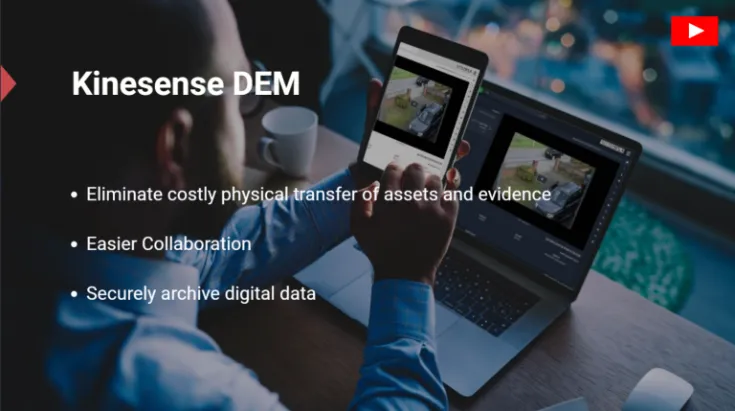
A DEAM replaces that with one place to store, retrieve and share every asset. Officers upload media to a case, tag it with searchable metadata, bookmark key moments and assign tasks to colleagues. Access for the Crown Prosecution Service and defence is controlled and logged rather than posted. Our ROI article works through the cashable savings in detail; in our experience they typically return the investment many times over.
That benefit holds wherever the system is hosted. The rest of the business case is about hosting: who runs the infrastructure, what it costs and how safe it is.
What are the deployment options?
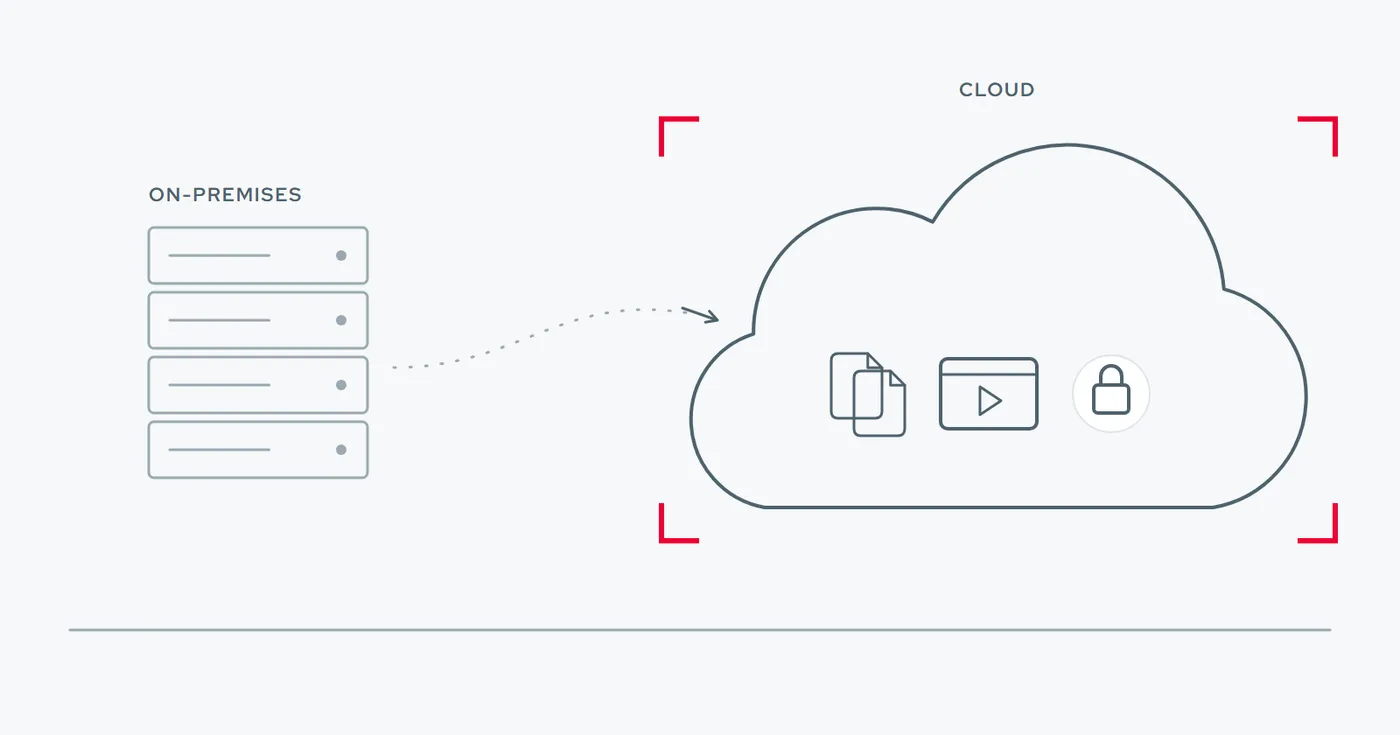
There are two broad routes. On-premises, the force buys, houses, powers, cools, patches and staffs the servers itself. In the cloud, a provider such as AWS or Azure runs the physical estate and the force pays for what it uses.
“Cloud” itself covers four models:
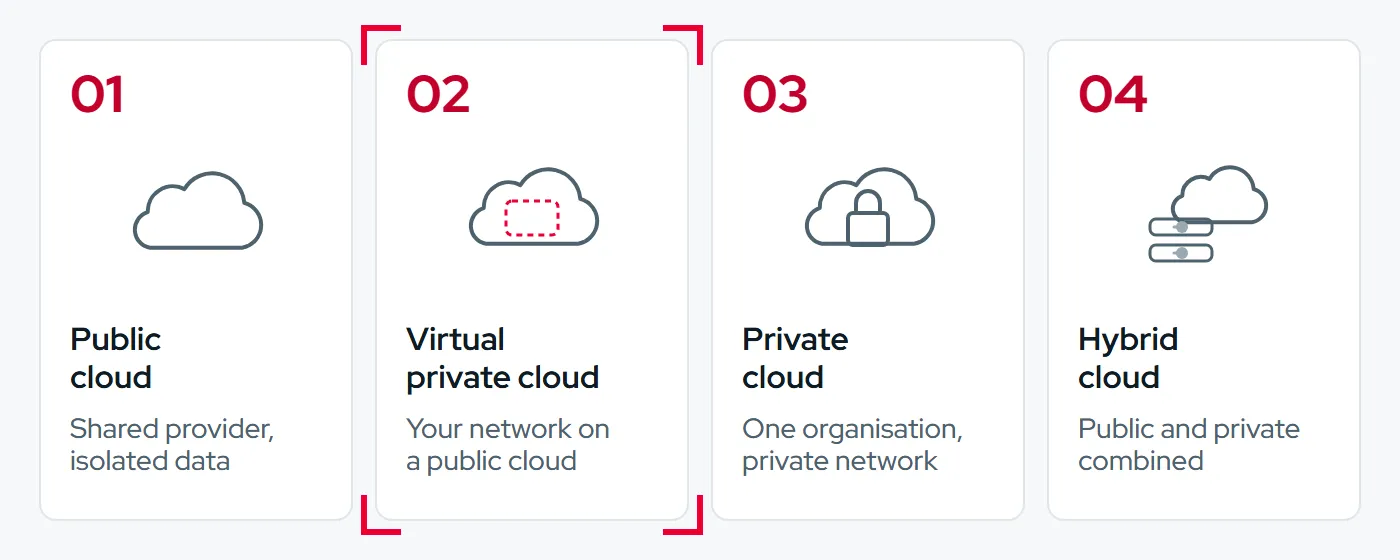
| Model | Who runs the infrastructure | Up-front cost | Scaling | Best when |
|---|---|---|---|---|
| On-premises | The force | High: building, network, servers | Buy more hardware | Policy forbids external hosting |
| Public cloud | Provider, shared with other customers (data isolated) | Low | On demand | Standard workloads, fast start |
| Virtual private cloud (VPC) | Provider; network defined by the force | Low | On demand | Evidential data needing isolation, at cloud cost |
| Private cloud | The force, or a contracted provider | High | Limited by the estate | An existing force or regional private cloud |
| Hybrid cloud | Both | Highest: pays for both | Mixed | Transitional estates |
For evidence, the virtual private cloud is usually the sweet spot. Web-facing services sit in a public subnet, while databases and storage sit in private subnets with no internet access. The force keeps the isolation of a private cloud without buying one. Kinesense DEAM runs this way on AWS by preference, with Azure available and on-premises deployment on request.
What does it cost: on-premises vs cloud
Hosting is separate from the software licence. This section compares only the infrastructure a DEAM runs on.
We modelled a regional deployment with:
- 10,000 users, 1,000 of them concurrent, for 12 hours a day
- 50 TB of archive migrated onto the platform at the start
- 40 TB of new content added each year
On-premises, the infrastructure alone came to about £920,000, spent in year one:
| On-premises item | Cost |
|---|---|
| Data-centre infrastructure (building, network, electrical) | £220,000 |
| Equipment (routers, switches) | £200,000 |
| Servers | £500,000 |
| Total, before staff, floor space, cooling and electricity | £920,000 |
In the cloud, hosting the same workload cost £479,317 over five years, paid as it was used:
| Year | Cloud hosting | Running total |
|---|---|---|
| 1 | £51,781 | £51,781 |
| 2 | £100,180 | £151,961 |
| 3 | £101,906 | £253,867 |
| 4 | £108,815 | £362,682 |
| 5 | £116,635 | £479,317 |
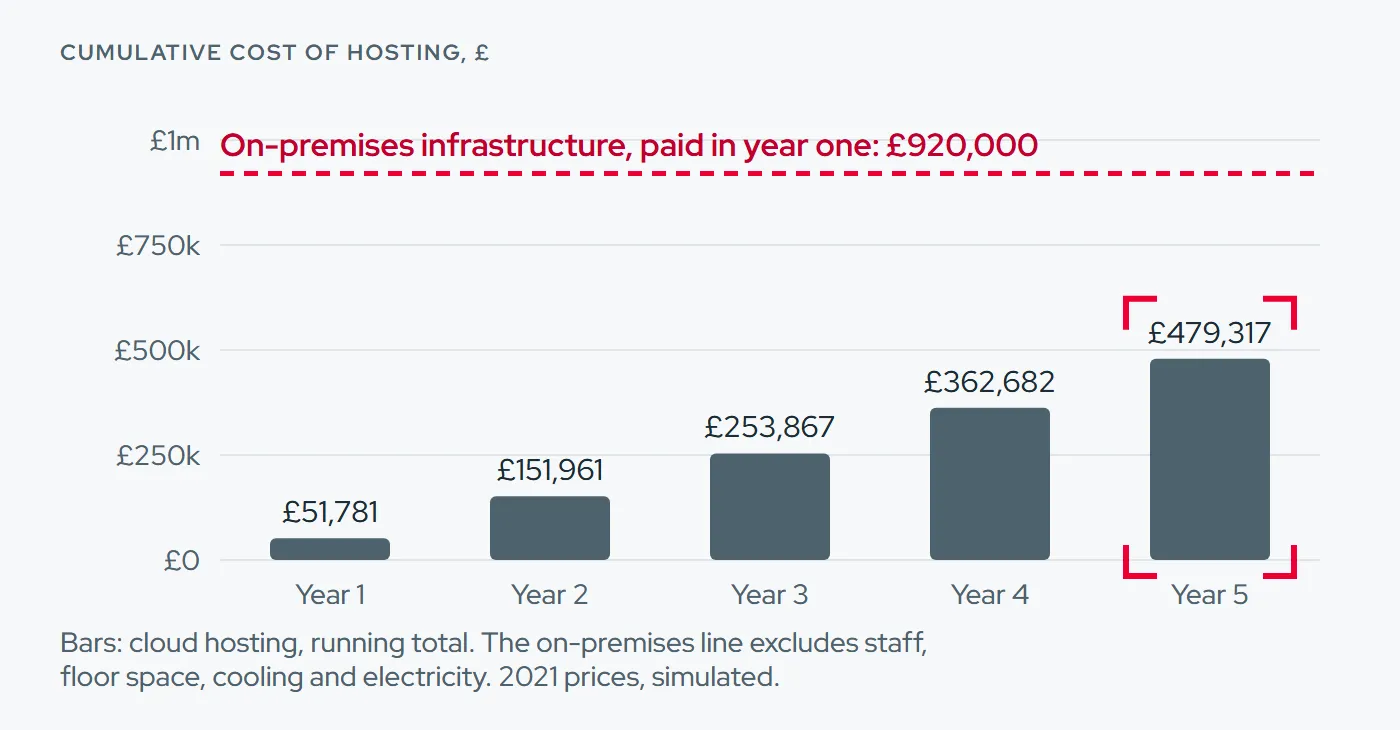
Three things make the gap wider than the headline figure:
- The on-premises figure is a floor. It leaves out the people to run the plant, the floor space, cooling and electricity, and the hardware refresh that falls due within five years. Power is not a footnote: we know of at least one force whose on-premises DEAM overloaded its building’s electrical supply.
- Capital vs operating spend. Cloud moves the cost from a large capital bid to a predictable operating line that grows with use. Criminal justice budgets increasingly prefer that, and it lets a force start small.
- Data keeps growing. On-premises capacity has to be bought ahead of need and guessed years in advance. Cloud storage grows with the data, and pairing it with Kinesense LE means officers upload the critical clips rather than whole recordings. That typically cuts an hour of footage to about two minutes of evidence.
Is the cloud secure enough for police evidence?
This used to be the objection that ended the conversation. It no longer is.
In a 2021 Kinesense survey of the 43 UK police forces, around 25 had deployed some form of DEAM. Half of those only handled their manufacturer’s body-worn video. Roughly 60% were hosted with third-party cloud providers. Policing had already made the decision; the question now is how well each system is built.
National security bodies reached the same view earlier. Speaking at the AWS Public Sector Summit in 2018, Sean Roche, then associate deputy director of the CIA’s Digital Innovation Directorate, said:
Security is an absolutely existential need for everything we do at the agency. The cloud on its weakest day is more secure than a client service solution.
In the UK, Rich Crowther, then head of the Defence Digital Service, set out in 2020 why Defence can secure OFFICIAL workloads better in public cloud than on-premises. Each of his three reasons applies directly to evidence:
- Patches land faster. When the Spectre processor flaws became public in 2018, cloud customers were protected within days, while on-premises estates waited months for chip and firmware fixes. Security fixes are needed in hours, not weeks.
- Controls roll out at scale. Network monitoring, administrator rights and audit logging come as ready-made services, rather than being built and maintained server by server.
- Everything can be authorised. Fine-grained identity makes separation of duties practical. In a DEAM that means who can view, export or share an exhibit, which changes constantly as cases move.
How Kinesense DEAM protects evidence in the cloud
Hosting on a secure cloud is necessary, not sufficient. These are the controls built into Kinesense DEAM itself:
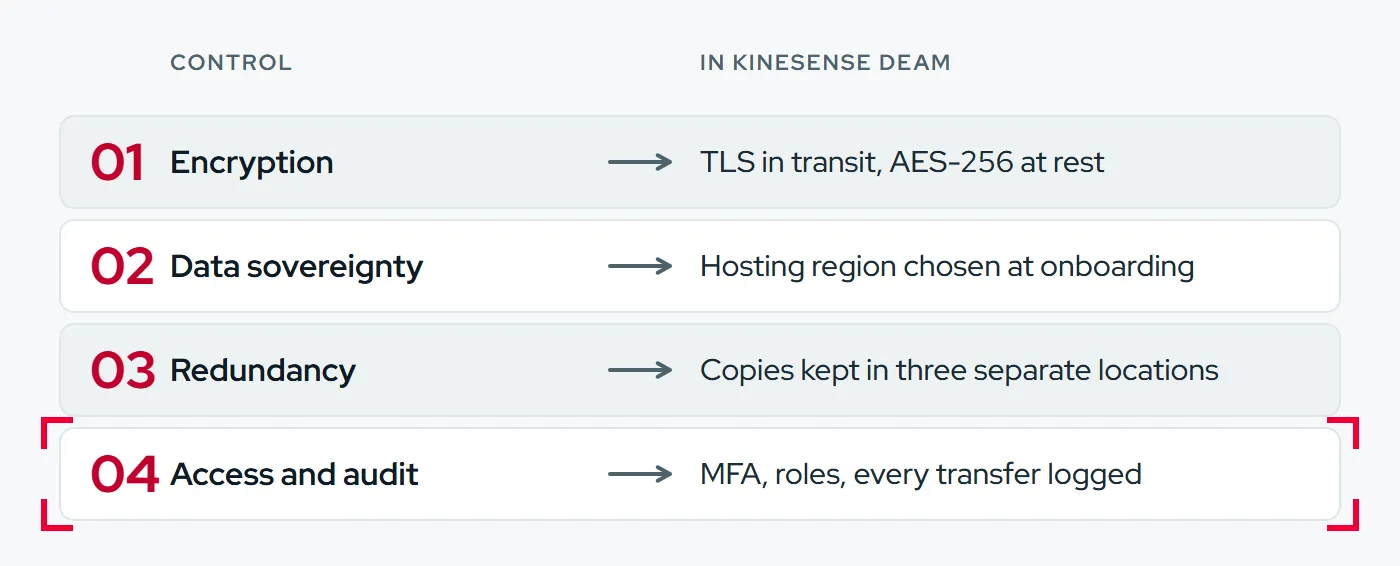
- Encryption. The platform is web-based and served over HTTPS, so everything between the user and DEAM is encrypted with TLS. Files uploaded to and downloaded from cloud storage are encrypted with AES-256.
- Data sovereignty. Government evidence should stay in its country of origin. The hosting region is chosen when each customer is onboarded. Every upload is kept as an original and a transcoded working copy in that region’s storage.
- Redundancy. Full and incremental backups run continuously. Storage is mirrored across three separate locations, geographically apart and isolated from the same environmental hazards.
- Access and audit. Logins use multi-factor authentication, and passwords are stored with modern cryptography following OWASP practice. Access is granted through customer-defined roles, which matters when labs, forensic partners or other agencies upload to a force’s account. Every transfer is tracked and time-stamped, so the audit chain for each exhibit is complete.
Not all cloud DEAMs are built the same
The hosting model is half the decision. The other half is how the DEAM software itself was built, and suppliers rarely volunteer it.
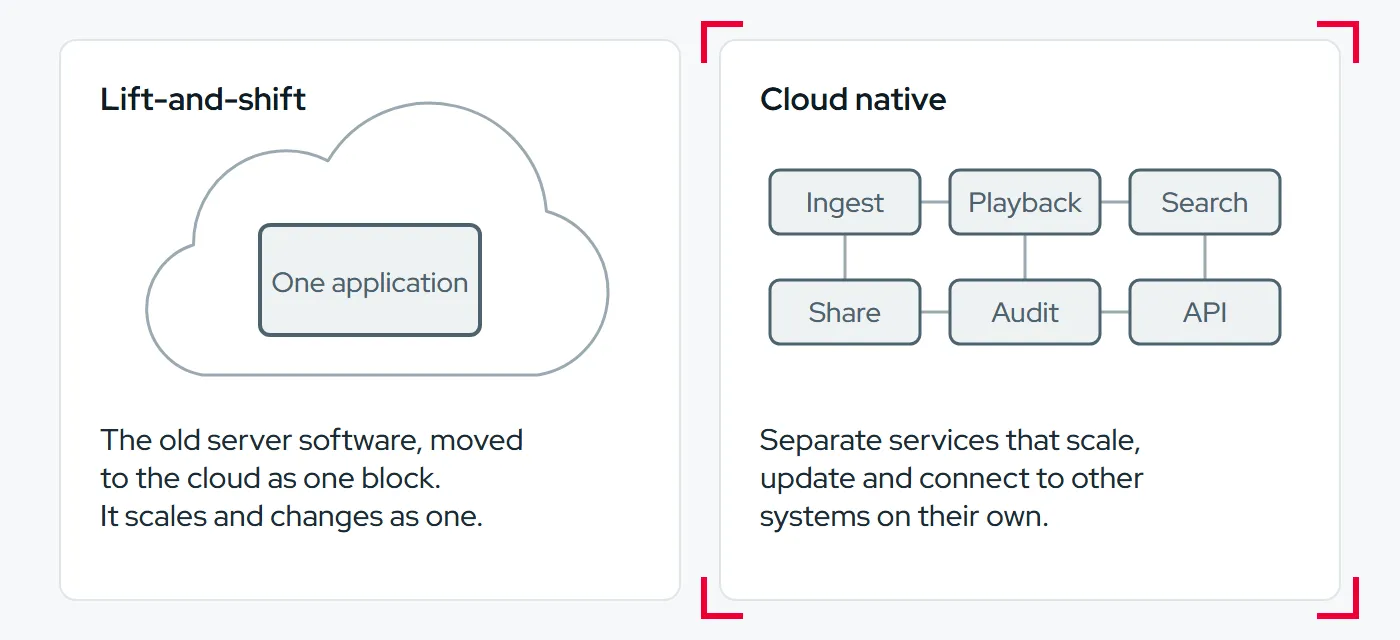
Lift-and-shift is the most common route for established products. The existing server software is moved into a cloud data centre largely unchanged. It gains remote access, but remains a monolith: hard to scale, slow to change and awkward to integrate. Those limits tend to show up later as cost.
Cloud native systems such as Kinesense DEAM are built as cloud services from the start. Each part scales with demand, and a full API connects the platform to case and records management systems, public portals and other tools. A force can adopt what it needs now and add to it as requirements grow.
Building your business case: a checklist
Most UK public bodies write business cases using HM Treasury’s Green Book five-case model. Here is what a DEAM case needs under each heading:
- Strategic case. Today’s evidence journeys, media spend, delays and data-loss incidents. Most of this is already in your force’s own records.
- Economic case. On-premises, private cloud and VPC options compared over at least five years, with staff, power, cooling and hardware refresh included on the on-premises side.
- Commercial case. Hosting region and data sovereignty, exit and data-return terms, and whether the supplier’s software is cloud native or lifted and shifted.
- Financial case. The shift from a capital bid to operating spend, and how hosting costs scale with your projected data growth.
- Management case. Rollout, training and role design. Check the supplier against the NCSC’s 14 Cloud Security Principles before contract, not after.
The cost and security arguments for hosting evidence in the cloud have largely been settled, by policing and by defence. What separates a good DEAM from an expensive one is how it is built, whether it can actually play the video your cases depend on, and whether its audit trail stands up in court. If you are building the case for your force, talk to us and we’ll help you model it against your own numbers.
Sources
- Kinesense, Why are police managing digital evidence on the cloud? (whitepaper, 2021). Cost model, survey of 43 UK police forces, and Kinesense DEAM security design.
- Kinesense DEAM product brief: deployment options, collection journeys and storage reduction. Kinesense DEAM product page
- Sean Roche, CIA, speaking at the AWS Public Sector Summit, June 2018. Reporting, Nextgov
- Rich Crowther, More secure in the public cloud, Defence Digital blog, 20 November 2020
- National Cyber Security Centre, Cloud Security Principles
- HM Treasury, The Green Book and the five-case model
Cost figures are simulated estimates, priced in 2021, and will change with prices and volumes. They cover infrastructure hosting only, not software licences.
Frequently asked questions
What is a DEAM system?
A digital evidence and asset management (DEAM) system is a web-based platform that brings every evidential asset in a case (CCTV and body-worn video, images, audio, interview recordings, documents and forensic images) into one secure location. Authorised users search, review, bookmark and share assets from a browser, and the system logs every upload, view, edit and share for the chain of evidence.
Is the cloud secure enough for police digital evidence?
For OFFICIAL data, increasingly yes. The UK's Defence Digital Service has argued that public cloud lets organisations patch faster, roll out security controls at scale and enforce separation of duties more easily than on-premises estates. What matters is the supplier's design: encryption in transit and at rest, data held in the force's own country, multi-factor authentication, role-based access and a full audit trail. The NCSC's Cloud Security Principles are a good checklist for assessing any supplier.
How much does a cloud DEAM cost compared with on-premises?
In a Kinesense model of a regional deployment (10,000 users, 1,000 concurrent, 50 TB of migrated archive and 40 TB of new content a year), on-premises infrastructure cost about £920,000 in year one, before staff, floor space, cooling and electricity. Cloud hosting for the same workload cost £479,317 over five years. The figures were priced in 2021 and are simulated, so a force should rerun them with its own volumes and current prices.
What is the difference between a virtual private cloud and a private cloud?
A private cloud runs on infrastructure dedicated to one organisation, managed in-house or by a contracted provider. A virtual private cloud (VPC) is a logically isolated network that the customer defines inside a public cloud such as AWS or Azure. A VPC can keep databases in private subnets with no internet access, while keeping the public cloud's scale and pay-as-you-go pricing.
Where is evidence stored in Kinesense DEAM?
Kinesense DEAM is hosted on AWS as the preferred platform, with Azure also available and on-premises deployment on request. The hosting region is chosen when a customer is onboarded, so evidence stays in its country of origin. Uploaded assets are kept as an original and a transcoded copy, encrypted with AES-256, and stored redundantly across three separate locations.
What does cloud native mean for a DEAM?
A cloud-native DEAM is built from the start as separate cloud services (ingest, playback, search, sharing, audit, APIs) that scale and update independently and integrate with other systems. A lift-and-shift DEAM is older server software moved into a cloud data centre as one block: it gains remote access, but still scales and changes as a single unit.